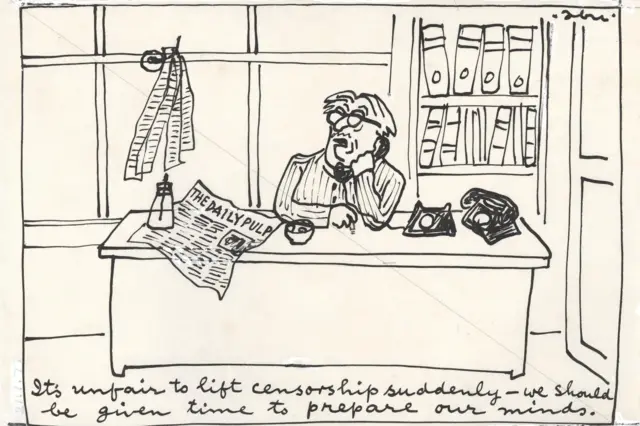
Abu Abraham n'était pas seulement un satiriste politique — il incarnait la résistance durant l'une des périodes les plus sombres de l'Inde. Quand la Première ministre Indira Gandhi a proclamé l'état d'urgence en 1975, suspendant les libertés civiles et emprisonnant des milliers d'opposants politiques, ce caricaturiste a fait de son crayon une arme de vérité, d'humour et de défi.
L'héritage d'Abu Abraham demeure un témoignage de la puissance de l'art face à l'autoritarisme. Ses dessins minimalistes et acérés se moquaient de l'arrogance du pouvoir, dénonçaient la censure et donnaient voix à une nation réduite au silence — tout en échappant aux interdictions et à la surveillance du gouvernement.
Pour des reportages historiques et culturels approfondis, visitez BBC History – Political Satire and Resistance in the 20th Century.
L'état d'urgence : l'éclipse démocratique de l'Inde
Quand la démocratie a été suspendue
C'est durant les 21 mois de l'état d'urgence (1975–1977) qu'Abu Abraham s'est fait connaître, une période où les institutions démocratiques de l'Inde ont été démantelées. La Première ministre Indira Gandhi, confrontée à une agitation politique et à une décision de justice qui menaçait sa position, a proclamé l'état d'urgence national le 25 juin 1975.
Selon un rapport de 2025 du Centre for the Study of Developing Societies (*source ici*), plus de 140 000 personnes ont été arrêtées sans jugement, la presse a été censurée et la dissidence politique criminalisée.
Sur notre rubrique Histoire de la satire politique, nous revenons sur la façon dont des caricaturistes, écrivains et artistes ont défié les régimes autoritaires à travers le monde.
La presse assiégée
Abu Abraham évoluait dans un contexte où les journaux étaient contraints de laisser des espaces vides à la place des articles censurés. Malgré tout, des publications comme *The Indian Express* et *The Statesman* trouvaient des moyens de résister — souvent en publiant un éditorial entièrement blanc, ou une caricature qui en disait plus que mille mots.
« Quand la presse est muselée, le caricaturiste devient la conscience de la nation », a déclaré un rédacteur en chef vétéran. « Abu ne dessinait pas — il témoignait. »
Les dessins d'Abraham ont été publiés dans *The Guardian* (Royaume-Uni) et *The Observer*, donnant une visibilité internationale à la crise démocratique que traversait l'Inde.
3 façons dont il a défié la tyrannie
Méthode n°1 : la puissance du trait unique
L'un des aspects les plus marquants du travail d'Abu Abraham était son style minimaliste. Pour lui, un seul trait pouvait en dire plus qu'un paragraphe entier. Sa caricature la plus célèbre de la période de l'état d'urgence montrait Indira Gandhi coiffée d'une couronne portant l'inscription « Emergency », avec un petit personnage étiqueté « Democracy » enfermé dans une cage à oiseaux à ses pieds.
L'image a été reproduite secrètement sur des tracts et circulait de main en main. « Ce n'était pas juste un dessin — c'était un cri de ralliement », a confié un militant étudiant de l'époque. « On le portait comme un drapeau. »
Cette économie de trait rendait ses œuvres faciles à reproduire et difficiles à interdire — un avantage stratégique dans un paysage médiatique censuré.
Méthode n°2 : la satire comme bouclier
Abu Abraham maîtrisait l'art de la satire comme bouclier. En recourant à l'humour, il désamorçait la peur que le régime nourrissait envers la dissidence. Les autorités répugnaient à arrêter un caricaturiste pour avoir « fait rire les gens » — même quand ce rire était chargé de fureur.
Dans une caricature, il représentait Sanjay Gandhi, le fils d'Indira et homme fort de facto durant l'état d'urgence, en marionnettiste dont les fils étaient étiquetés « Presse », « Police » et « Parlement ». La légende disait : « Le nouveau roi de l'Inde. »
« L'humour est la seule arme qui permet de se moquer du pouvoir sans se faire tuer », a déclaré Abraham dans une interview de 1982. « Les dictateurs détestent être tournés en ridicule — ça met à nu leur fragilité. »
Méthode n°3 : l'exil comme tribune
Quand la censure s'est intensifiée, Abu Abraham a quitté l'Inde pour Londres en 1976, où il a continué à publier ses dessins dans *The Guardian*. Depuis l'exil, sa voix s'est amplifiée, touchant à la fois la diaspora indienne et un public international.
Ses caricatures étaient introduites clandestinement en Inde, photocopiées et distribuées dans des réseaux souterrains. « On n'avait pas besoin de satellites — on avait des photocopieuses et du courage », a dit un journaliste qui a travaillé avec lui.
Sa tribune internationale a obligé le gouvernement indien à faire face aux critiques mondiales, accentuant la pression pour mettre fin à l'état d'urgence.
L'art de la résistance : des dessins qui ont changé l'histoire
Du croquis au symbole
Abu Abraham ne commentait pas seulement l'histoire — il la façonnait. Ses images sont devenues des symboles du mouvement anti-état d'urgence. Une caricature montrait un homme balayant de la poussière étiquetée « Vérité » sous un tapis intitulé « Censure », avec la légende : « Où va la vérité ? »
Cette image a ensuite été utilisée dans des campagnes politiques après la fin de l'état d'urgence, contribuant à la défaite d'Indira Gandhi aux élections de 1977.
« Un dessin ne peut pas renverser un dictateur », a dit un stratège politique. « Mais il peut amener les gens à croire que le changement est possible. »
Un héritage de courage
L'héritage d'Abu Abraham dépasse les frontières de l'Inde. Il a inspiré des générations de caricaturistes politiques à travers l'Asie, l'Afrique et l'Amérique latine.
En 2025, l'UNESCO l'a honoré en tant que « Défenseur de la liberté d'expression », et le Press Institute of India a créé le Abu Abraham Award for Courage in Satire, remis chaque année.
« Il a prouvé qu'un crayon peut être plus puissant qu'une épée — et bien plus dangereux pour les tyrans », a déclaré le premier lauréat du prix.
La vie d'Abu Abraham
Du Kerala à la scène internationale
Né en 1924 au Kerala, Abu Abraham a commencé à dessiner très jeune, publiant dans des journaux locaux avant de rejoindre Delhi. Il a étudié à la Slade School of Fine Art de Londres et a travaillé pour *The Observer* et *The Sunday Times*.
On le connaissait non seulement pour ses caricatures politiques, mais aussi pour son profond humanisme. « Je ne hais pas les puissants », disait-il. « Je les plains — ils vivent dans la peur de la vérité. »
Mort en 2002, son œuvre reste une référence pour les défenseurs de la liberté d'expression.
Une voix pour ceux qu'on n'entend pas
Abu Abraham croyait que les caricatures devaient parler pour les sans-voix. Il dessinait souvent des paysans, des ouvriers et des étudiants — la grande majorité silencieuse écrasée par les politiques autoritaires.
« Le rôle du caricaturiste n'est pas de divertir les élites », disait-il. « C'est de réconforter les affligés et d'affliger ceux qui sont à l'aise. »
Ce principe a guidé tout son travail — de l'état d'urgence à ses critiques de la corruption et des inégalités dans les années 1980 et 90.
L'avenir de la satire politique
La caricature à l'ère du numérique
L'héritage d'Abu Abraham se perpétue à l'ère numérique. Les caricaturistes d'aujourd'hui utilisent les réseaux sociaux, les mèmes et l'animation pour défier le pouvoir — mais ils font face à de nouvelles menaces : le harcèlement en ligne, la suppression algorithmique et la surveillance étatique.
Pourtant, la mission reste la même : dire la vérité au pouvoir avec esprit et courage.
« On se tient sur les épaules de géants comme Abu », a dit un jeune caricaturiste indien. « Son arme, c'était son crayon. La nôtre, c'est nos pixels. »
Un message intemporel
L'histoire d'Abu Abraham ne parle pas seulement du passé — c'est aussi un avertissement pour l'avenir. Alors que les démocraties du monde entier font face à l'érosion, sa vie nous rappelle que la liberté d'expression n'est pas un luxe — c'est une nécessité.
« Quand le silence est imposé, l'art devient rébellion », a dit un historien. « Et Abu Abraham était le rebelle le plus silencieux et le plus retentissant à la fois. »
Son héritage perdurera — un trait, un éclat de rire, une vérité à la fois.
Source de l'article : https://www.bbc.com